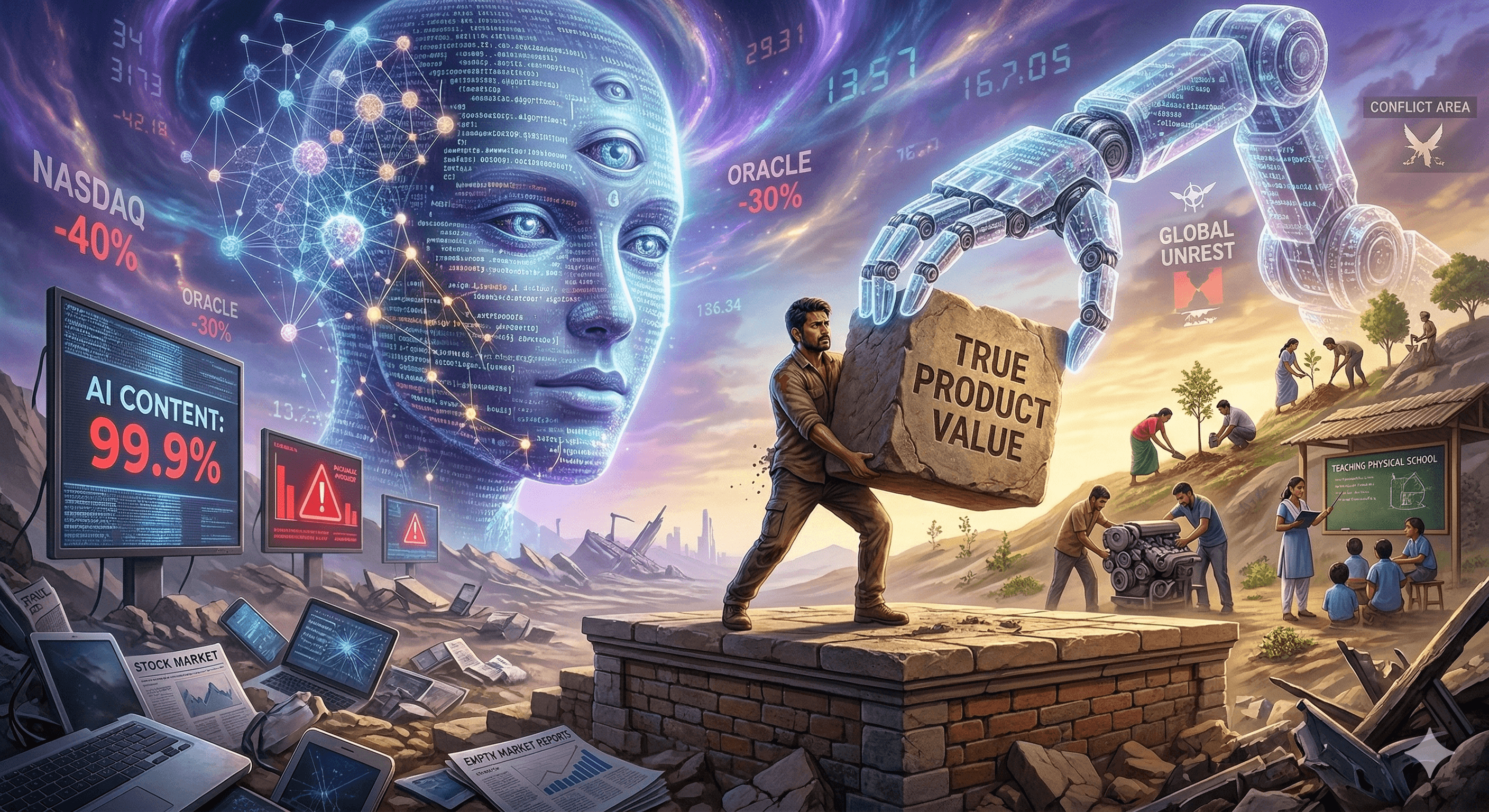
The screen shows the stock market taking yet another violent swing. Geopolitical tensions flare up, and suddenly billions are wiped off tech valuations in a matter of hours. Meanwhile, on another screen, an AI agent is quietly spinning up complex backend architecture in roughly fourteen seconds.
If you are building digital products today, you are likely asking yourself a very heavy question. In an era where algorithms can write our software and global markets punish tech stocks without warning, what is the actual value of a digital product?
The answer requires a complete rewiring of how we view our work and our worth.

The Illusion of Digital Permanence
Consider the reality hitting the tech industry right now. Oracle recently eliminated thirty thousand jobs globally, with twelve thousand people waking up to a cold termination email. The stated reason is simple. AI coding tools are allowing smaller engineering teams to deliver faster. Meanwhile, giants like Microsoft have seen massive stock plunges, dropping thirty percent as market panic and immense AI infrastructure spending spook investors.
Imagine a person heavily invested in those stocks watching eight million dollars vanish from their portfolio in a single afternoon. In that exact moment, what is the actual, tangible value of that digital wealth? What is the true valuation of a software product when the very foundation of the market is so fragile?
If you are a product manager, a developer, or working in customer support, the ground is shifting beneath your feet. AI is not just learning. It is executing. It is handling client service, writing code, and drafting roadmaps with increasing precision every single day. The idea that AI will replace the digital service layer is no longer a distant warning. It is the current business strategy of the largest companies on the planet.
The Great Reversal to Physical Reality
There is no point in fighting the algorithm on its own turf. If anything can be generated digitally, then digital generation loses its premium. So, where are we heading? How do we generate real value when the digital world is completely automated?
We are looking at a massive rotation back to the physical world. For decades, the ultimate goal was escaping physical labor to provide a digital service from behind a screen. Now, AI is claiming the screen.
The next big thing is not another piece of software. It is a return to tangible, physical services that algorithms cannot touch. An AI can write a brilliant tax optimization script, but it cannot physically show up to fix a leaking roof while you wait for the engineer. It cannot cook a warm plate of curry, and it cannot provide in person human care. As the digital realm becomes fully commoditized, the premium on human physical presence, craftsmanship, and real world problem solving will skyrocket.
Adapting to the Next Era
The purpose of acknowledging this is not to invoke fear. Fear paralyzes. The goal is to force the brain to start thinking beyond the current paradigm. The era of the comfortable digital desk job is evolving rapidly, but human ingenuity remains.
Instead of asking how to build a better software feature, we must start asking how to bridge the gap between AI efficiency and human reality. The survival strategy is not competing with AI. It is moving to the spaces where AI cannot go. The builders of the next decade will be the ones who recognize that when the digital world costs nothing, the physical world becomes everything. It is time to look away from the screen and start figuring out what people actually need in the real, physical world.
The tools we use will change, and the medium of our work will shift, but the fundamental need to engage with reality remains our ultimate responsibility. As Johann Wolfgang von Goethe wrote regarding the necessity of moving from abstract thought to tangible action:
Knowing is not enough; we must apply. Willing is not enough; we must do.