Welcome to the modern corporate world. We are a brilliant group of professionals who have mastered the dark art of sounding incredibly important while doing the exact same thing our ancestors did around a campfire: trying to get people to agree on a plan without completely losing their minds.
We wrap our daily tasks in complex vocabulary because if we admitted what we actually do, the illusion would shatter. Here is the unvarnished truth about the words we use versus the reality we live.
The Archetypes
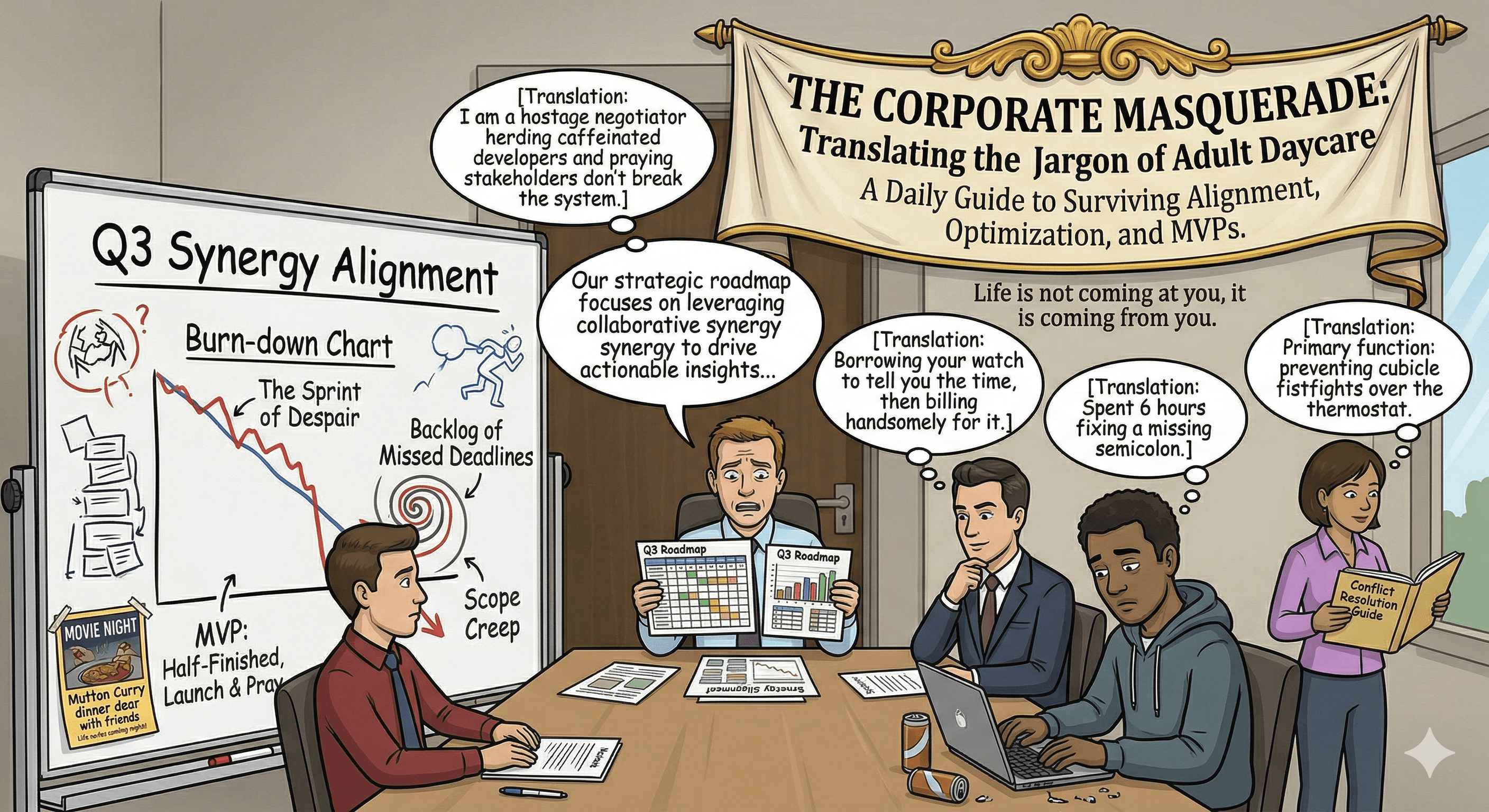
The Product Manager The title sounds like a visionary architect of the digital future. You are told you will be the CEO of the product. The reality? You are a hostage negotiator and an adult daycare coordinator. You spend your days herding highly caffeinated developers, begging people to read the requirements document, and explaining to eager stakeholders that adding one magical button to the app will somehow break the entire backend architecture. You are not Steve Jobs. You are someone whose primary weapon is a politely worded email and an increasingly colorful spreadsheet.
The Full Stack Developer They are portrayed as digital wizards who speak in binary and build empires from lines of code. In reality, they are deeply frustrated individuals who spend eighty percent of their week trying to fix a bug, only to realize they forgot a semicolon. Their greatest nemesis is not a rival tech company, but the Product Manager who just asked if they can quickly squeeze in a minor feature before Friday.
The Strategy Consultant Armed with pristine slide decks full of upward trending arrows, they appear to hold the secrets of the universe. Their actual job is to borrow your watch to tell you the time. They interview the ground floor employees, repackage the exact things those employees have been saying for three years, put it in a sleek presentation, and then bill the company handsomely for the privilege.
People Operations They rebranded from Human Resources to People Operations to sound like they are optimizing human potential and driving cultural growth. In reality, they are the corporate bouncers and camp counselors. Their primary function is ensuring that two adults who sit in adjacent cubicles do not start a physical altercation over the thermostat setting or missing Tupperware in the breakroom.
The Rituals
The Synergy Alignment Meeting In theory, this is a calculated merging of cross functional minds to brainstorm our next big venture. In practice, it is a gathering where twelve people watch two people argue about a minor detail, while the other ten secretly reply to emails, scroll through their phones, and desperately try to decide what to order for lunch on Zomato.
The Agile Sprint Retrospective This is supposed to be a strategic review of an optimized workflow. In truth, it is corporate group therapy. It is the one hour every two weeks where everyone complains about the exact same deployment bottlenecks they complained about last time, while a Scrum Master enthusiastically moves virtual sticky notes around a digital whiteboard.
The Quarterly Town Hall A grand assembly where executives stand in front of a giant screen and use words like headwinds and runway to explain why nobody is getting a bonus this year, despite the company having record breaking profits. Everyone claps politely while updating their resumes on the sly.
The Performance Review This is corporate astrology. It is an intricate, highly documented dance where you pretend to have deep areas for growth and a profound passion for the company mission, while your manager pretends the corporate budget actually allows for a meaningful raise.
The Dictionary of Deflection
We have engineered an entire vocabulary designed specifically to manage other people without hurting their feelings or causing a legal incident.
- "Per my last email" Translation: I am politely letting you know that you lack basic reading comprehension.
- "Let us take this offline" Translation: Please stop talking right now before the client realizes we have absolutely no idea what we are doing.
- "I do not have the bandwidth" Translation: I have exactly enough time to do my own work and absolutely zero time to do yours.
- "We are building an MVP" Translation: We are completely out of time and budget, so we are going to launch this half finished thing and pray the users do not notice the missing features.
- "Moving forward" Translation: Please stop pointing out the massive mistake I made yesterday.
- "Just bubbling this up to the top of your inbox" Translation: You ignored my last three messages, and I am now escalating my passive aggression to formal documentation.
- "We need to pivot" Translation: The original idea failed spectacularly, and we are desperately throwing things at the wall to see what sticks.
- "Let us put a pin in that" Translation: I am acknowledging your terrible idea in public, but I am going to make sure we never, ever discuss it again.
The Philosophical Truth
Why do we wear this elaborate linguistic armor? Perhaps it is a necessary coping mechanism. If we admitted that cloud architecture is just renting a computer from someone else, or that optimizing collaborative synergy just means skipping a meeting to send a quick message, the magic would disappear.
The Ultimate Translation: Living
At the end of all the strategic roadmaps and quarterly alignments, here is the real truth: life is not coming at you, it is coming from you.
Be clever. Use your brain at your job in a way that solves the problems without letting the corporate machine drain your soul. Protect your energy fiercely. Because the real deliverables are not found in a spreadsheet or a status update.
Real life is the people around you. It is choosing to happily waste three hours on a movie. It is roaming around the city with your friends. It is stepping away from the screen to slowly cook a massive batch of mutton curry for the people you care about. Your job is simply the financial engine that funds your actual existence. So close the laptop, leave the jargon at the office, and go live your life.
Welcome to the modern corporate world. We are a brilliant group of professionals who have mastered the dark art of sounding incredibly important while doing the exact same thing our ancestors did around a campfire: trying to get people to agree on a plan without completely losing their minds.
We wrap our daily tasks in complex vocabulary because if we admitted what we actually do, the illusion would shatter. Here is the unvarnished truth about the words we use versus the reality we live.
The Archetypes
The Product Manager The title sounds like a visionary architect of the digital future. You are told you will be the CEO of the product. The reality? You are a hostage negotiator and an adult daycare coordinator. You spend your days herding highly caffeinated developers, begging people to read the requirements document, and explaining to eager stakeholders that adding one magical button to the mobile app will somehow break the entire backend architecture. You are not Steve Jobs. You are someone whose primary weapon is a politely worded email and an increasingly colorful spreadsheet.
The Full Stack Developer They are portrayed as digital wizards who speak in binary and build empires from lines of code. In reality, they are deeply frustrated individuals who spend eighty percent of their week trying to fix a bug, only to realize they forgot a semicolon. Their greatest nemesis is not a rival tech company, but the Product Manager who just asked if they can quickly squeeze in a minor feature before Friday.
The Strategy Consultant Armed with pristine slide decks full of upward trending arrows, they appear to hold the secrets of the universe. Their actual job is to borrow your watch to tell you the time. They interview the ground floor employees, repackage the exact things those employees have been saying for three years, put it in a sleek presentation, and then bill the company handsomely for the privilege.
People Operations They rebranded from Human Resources to People Operations to sound like they are optimizing human potential and driving cultural growth. In reality, they are the corporate bouncers and camp counselors. Their primary function is ensuring that two adults who sit in adjacent cubicles do not start a physical altercation over the thermostat setting or missing Tupperware in the breakroom.
The Rituals
The Synergy Alignment Meeting In theory, this is a calculated merging of cross functional minds to brainstorm our next big venture. In practice, it is a gathering where twelve people watch two people argue about a minor detail, while the other ten secretly reply to emails, scroll through their phones, and desperately try to decide what to order for lunch on Zomato.
The Agile Sprint Retrospective This is supposed to be a strategic review of an optimized workflow. In truth, it is corporate group therapy. It is the one hour every two weeks where everyone complains about the exact same deployment bottlenecks they complained about last time, while a Scrum Master enthusiastically moves virtual sticky notes around a digital whiteboard.
The Quarterly Town Hall A grand assembly where executives stand in front of a giant screen and use words like headwinds and runway to explain why nobody is getting a bonus this year, despite the company having record breaking profits. Everyone claps politely while updating their resumes on the sly.
The Performance Review This is corporate astrology. It is an intricate, highly documented dance where you pretend to have deep areas for growth and a profound passion for the company mission, while your manager pretends the corporate budget actually allows for a meaningful raise.
The Dictionary of Deflection
We have engineered an entire vocabulary designed specifically to manage other people without hurting their feelings or causing a legal incident.
- "Per my last email" Translation: I am politely letting you know that you lack basic reading comprehension.
- "Let us take this offline" Translation: Please stop talking right now before the client realizes we have absolutely no idea what we are doing.
- "I do not have the bandwidth" Translation: I have exactly enough time to do my own work and absolutely zero time to do yours.
- "We are building an MVP" Translation: We are completely out of time and budget, so we are going to launch this half finished thing and pray the users do not notice the missing features.
- "Moving forward" Translation: Please stop pointing out the massive mistake I made yesterday.
- "Just bubbling this up to the top of your inbox" Translation: You ignored my last three messages, and I am now escalating my passive aggression to formal documentation.
- "We need to pivot" Translation: The original idea failed spectacularly, and we are desperately throwing things at the wall to see what sticks.
- "Let us put a pin in that" Translation: I am acknowledging your terrible idea in public, but I am going to make sure we never, ever discuss it again.
The Philosophical Truth
Why do we wear this elaborate linguistic armor? Perhaps it is a necessary coping mechanism. If we admitted that cloud architecture is just renting a computer from someone else, or that optimizing collaborative synergy just means skipping a meeting to send a quick message, the magic would disappear.
The Ultimate Translation: Living
At the end of all the strategic roadmaps and quarterly alignments, here is the real truth: life is not coming at you, it is coming from you.
Be clever. Use your brain at your job in a way that solves the problems without letting the corporate machine drain your soul. Protect your energy fiercely. Because the real deliverables are not found in a spreadsheet or a status update.
Real life is the people around you. It is choosing to happily waste three hours on a movie. It is roaming around the city with your friends. It is stepping away from the screen to slowly cook a massive batch of mutton curry for the people you care about. Your job is simply the financial engine that funds your actual existence. So close the laptop, leave the jargon at the office, and go live your life.
Your title is just a rental, and your job is merely the financial engine for your existence. Do not let the corporate masquerade drain the brilliance you need for the people who actually matter. Life is not coming at you; it is coming from you. Close the laptop and go live it."