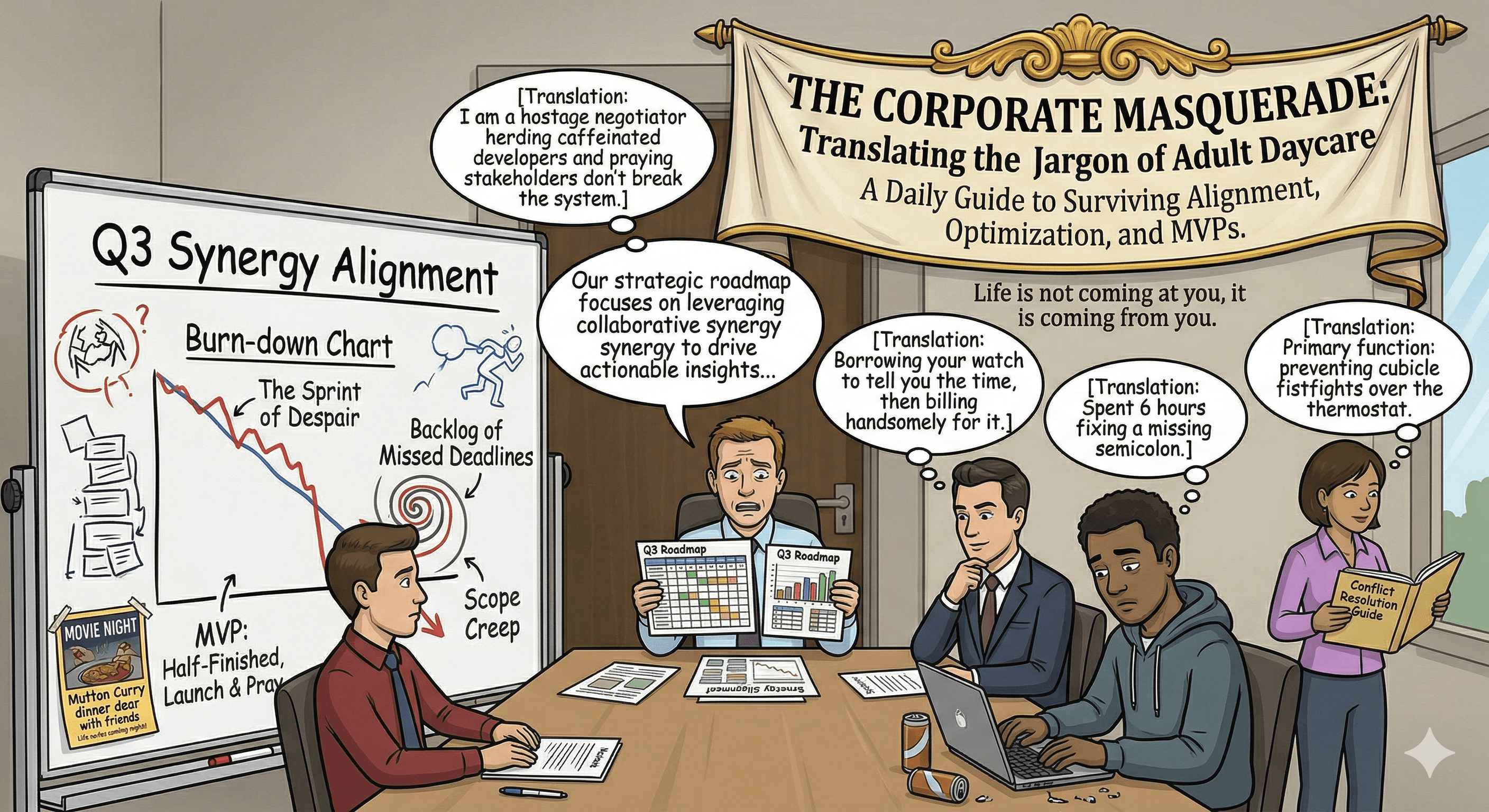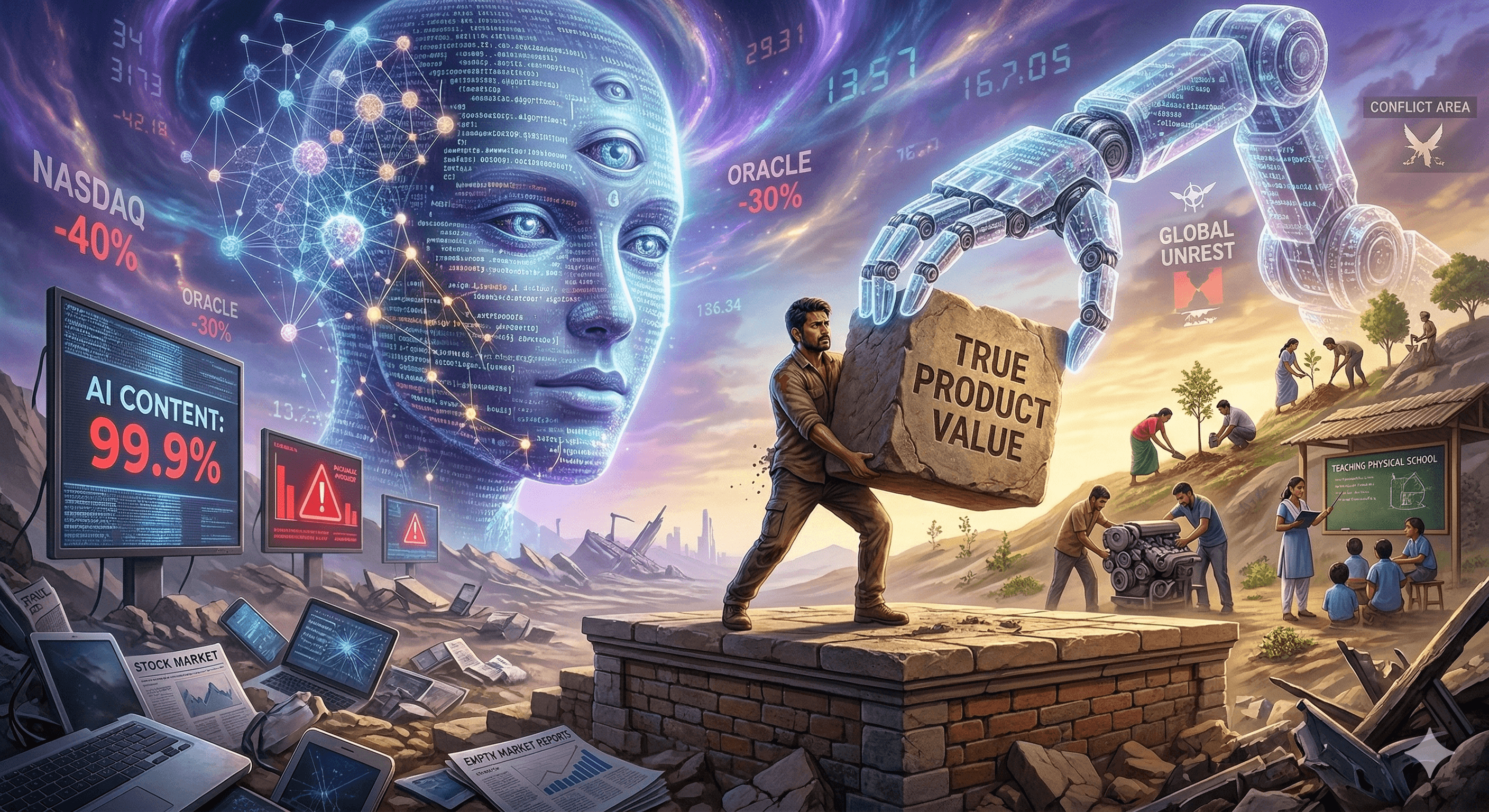
Welcome back to the circus.
Grab a coffee. Close your calendar. Ignore the twenty unread messages asking for alignment on a document nobody is going to read anyway. We need to have a deeply uncomfortable conversation about the reality of Product Management today. This is going to take a few minutes, but it is the exact truth you have been feeling in your gut every Sunday evening when the dread sets in.
You were sold a very specific dream when you entered this field. You were told you would be the visionary. You were told you would sit at the intersection of business, technology, and user experience. You believed you would spend your days identifying deep market problems, interviewing actual humans, and building elegant solutions to solve their pain points.
That was a beautifully marketed lie.
You are not a product builder. You are a highly paid diplomat trapped in a system that runs entirely on optics. We call this the Proactive Trap, and it is the silent killer of great software and the breeding ground for absolute burnout.
Let us break down exactly how this trap operates and why it is sapping your will to live, week after week.
The Visibility Illusion
In modern tech, proactivity is a bastardized metric. It is not measured by shipping code or closing user feedback loops. It is measured by the sheer volume of your digital footprint. If leadership does not see your name attached to the updates, you are just a passenger. The person fixing the critical bug is invisible. The person reacting to the fix announcement with a rocket emoji is proactive.
Think about the last time you pulled a miracle to save a release. You wrestled with the database, you calmed down the lead engineer, and you got it across the finish line. Then, someone else posts the victory message in the general channel. They get the praise. You get another ticket in the backlog. We have created a culture that rewards the narration of work above the execution of work. If your avatar is not popping up in the executive channels with high visibility summaries, the organization assumes you are not doing anything at all. You become a ghost haunting your own product.
The Meeting Mirage and the Death of Execution
This performative proactivity bleeds directly into how we spend our time. Look at your calendar right now. It looks like a game of Tetris you are actively losing.
We have replaced the pursuit of value with the pursuit of consensus. You do not spend your week building. You spend eighty percent of your week in meetings discussing the work, planning the work, aligning on the work, and mitigating the political fallout of the work. You have the pre meeting to prepare for the alignment meeting, and then the post sync to debrief what was said. Actual time spent building the product? Maybe two hours on a Friday afternoon when everyone else has logged off and the chat notifications finally stop pinging.
These alignment meetings are not about improving the product. They are corporate theater.
Think about the last time you tried to ship a minor update to the user onboarding flow. You wrote a simple one page document. Then Marketing requested a quick sync to discuss brand voice. Legal forwarded it to Compliance. Suddenly, you are hosting a recurring Thursday sync with fourteen people who have never spoken to a customer. You spend forty five minutes debating if the skip button should be rounded or square to optimize the omnichannel journey. Meanwhile, the actual registration database has been failing silently in the background for a week, and nobody in the room cares because the database does not have a visual interface they can leave a comment on.
Stakeholders attend not to contribute value, but to ensure their department feels represented in the room. They manufacture proactivity by throwing artificial roadblocks in your way. You are forced to host hostage negotiations disguised as feedback sessions. If you ignore their trivial comments about button colors, you are labeled difficult and not a team player. If you engage, you lose a week of engineering time debating nonsense.
The Jargon Smokescreen
Because the actual work has been replaced by the performance of work, the language we use has mutated into something unrecognizable. What is the product actually supposed to do? Ask any three leaders in your company and you will get three completely different answers wrapped in incomprehensible buzzwords.
We talk about synergizing the platform ecosystem, leveraging cross functional paradigms, and optimizing the omnichannel flywheel. It gets confusing. It gets irritating. It completely obscures the core value proposition.
Do you know why we use this jargon? Because it is a defense mechanism. It is a smokescreen to hide the terrifying reality that nobody in the leadership chain actually knows what the users want. If you describe a feature plainly, people can debate its merits and point out its flaws. If you wrap it in strategic jargon and put it on a slide with a few arrows, people just nod in agreement because they are too afraid to admit they have no idea what you are talking about. The product loses its identity under a mountain of corporate vocabulary, and you lose your sanity trying to decipher it.
The Stakeholder Pleasing Epidemic
This brings us to the most painful question of all. Ask yourself this honestly, and sit with the answer.
When was the last time you built a feature that an actual user needed, used, and loved?
Now, ask yourself when was the last time you built a feature solely because the Vice President of Sales promised it to a legacy client to save a quarter end deal? Or because the Marketing Director needed something shiny for an upcoming press release? Or because a board member read a trending article about Artificial Intelligence and demanded you integrate a chatbot into a product that barely has a functioning search bar?
We are no longer building software for the market. We are building software to please the organizational chart. The user is an afterthought, a convenient metric we pull out only when it supports the internal narrative. The true customer is the internal stakeholder who holds the power to approve your promotion. You are shipping features to buy political capital, not to solve human problems.
The Energy Vampire
This is exactly why you are so exhausted all the time. Building things gives you energy. Solving a complex technical problem gives you a dopamine hit. Seeing a user successfully navigate your flow feels amazing.
Navigating artificial corporate friction drains your soul.
The Proactive Trap saps your energy because your brain knows it is engaged in a pointless exercise. You are suffering from massive organizational debt. You are spending your finite cognitive resources managing egos, translating jargon, and fighting for visibility in chat channels instead of doing the deep, meaningful work you actually love. It is intellectual manual labor. It is exhausting because you are constantly context switching between pretending to care about the synergy flywheel and trying to figure out why the API is timing out.
The Brutal Conclusion
The corporate theater will not stop. The meetings will not suddenly disappear. Stakeholders will always try to justify their own existence by setting your roadmap on fire.
But you do not have to be a victim of the circus. You can become the ringmaster.
Stop playing defense. Stop accepting the defeatist mindset that you have to sneak your actual work into Friday nights. It is time to weaponize the system against itself.
If they want visibility, give it to them aggressively. Do not just react with emojis. Drop brutal, undeniable data points in the main channel that shut down their jargon. When a stakeholder asks for a useless vanity feature to appease a single client, do not argue with them in private. Publicly ask them to quantify the projected revenue impact against the engineering cost in the main alignment thread. Force them to do the math in front of the executives. They will retreat.
Build a massive, impenetrable wall around your engineering team. Let the stakeholders scream in the alignment documents. You absorb the political damage, you play the villain if you have to, so your developers can actually build.
You have to detach your self worth from their broken metrics. Stop trying to be the beloved diplomat who pleases everyone. Become the ruthless operator who ships real value. You are not here to please the organizational chart. You are here to build things that matter. Let them have the chat channels.
You take the market.
Stop surviving the circus. Start running it