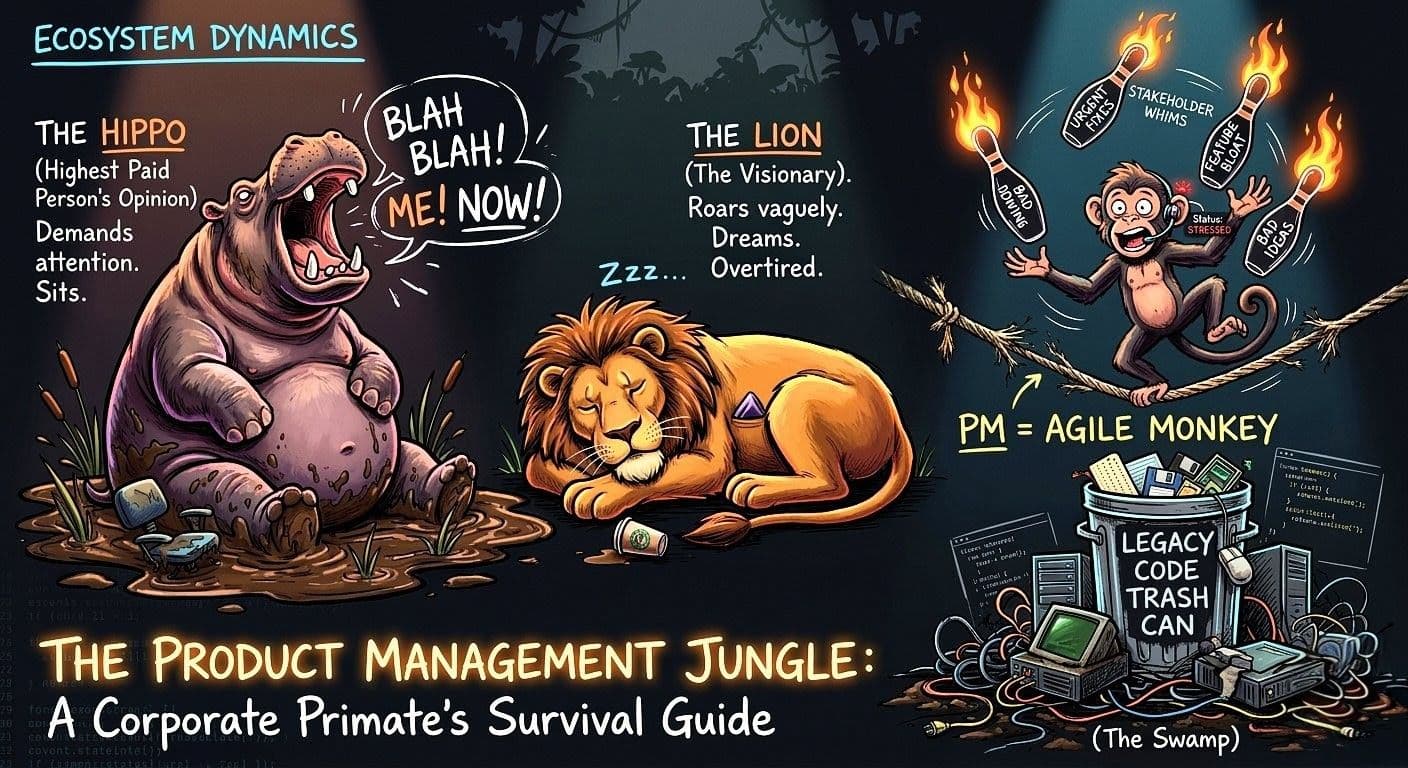
Let us be honest for a second. If you look at a Product Manager in their natural habitat, they do not look like the visionary CEO of the Product that business school promised. They look suspiciously like a monkey in a suit, frantically juggling flaming bowling pins while riding a unicycle on a tightrope.
And the worst part? Half the time, the tightrope is strung across a swamp of legacy code, and the flaming bowling pins are features that absolutely no one asked for.
Let us dissect the primate existence of the modern PM, look at what the job is actually supposed to be, and figure out why embracing your inner monkey is the ultimate power move.
The Evolution of the PM Primate
If you have spent any time in the trenches, you have seen the PM assume several personas depending on the day of the week:
- The Monkey in the Middle: You are the squishy buffer zone between two entirely different species. On one side, your engineering team is begging for a six month freeze to rewrite the backend because the tech debt is physically hurting them. On the other side, a key stakeholder just promised a massive generative AI integration by Friday because they read an article on an airplane. You belong to everyone, and therefore, no one.
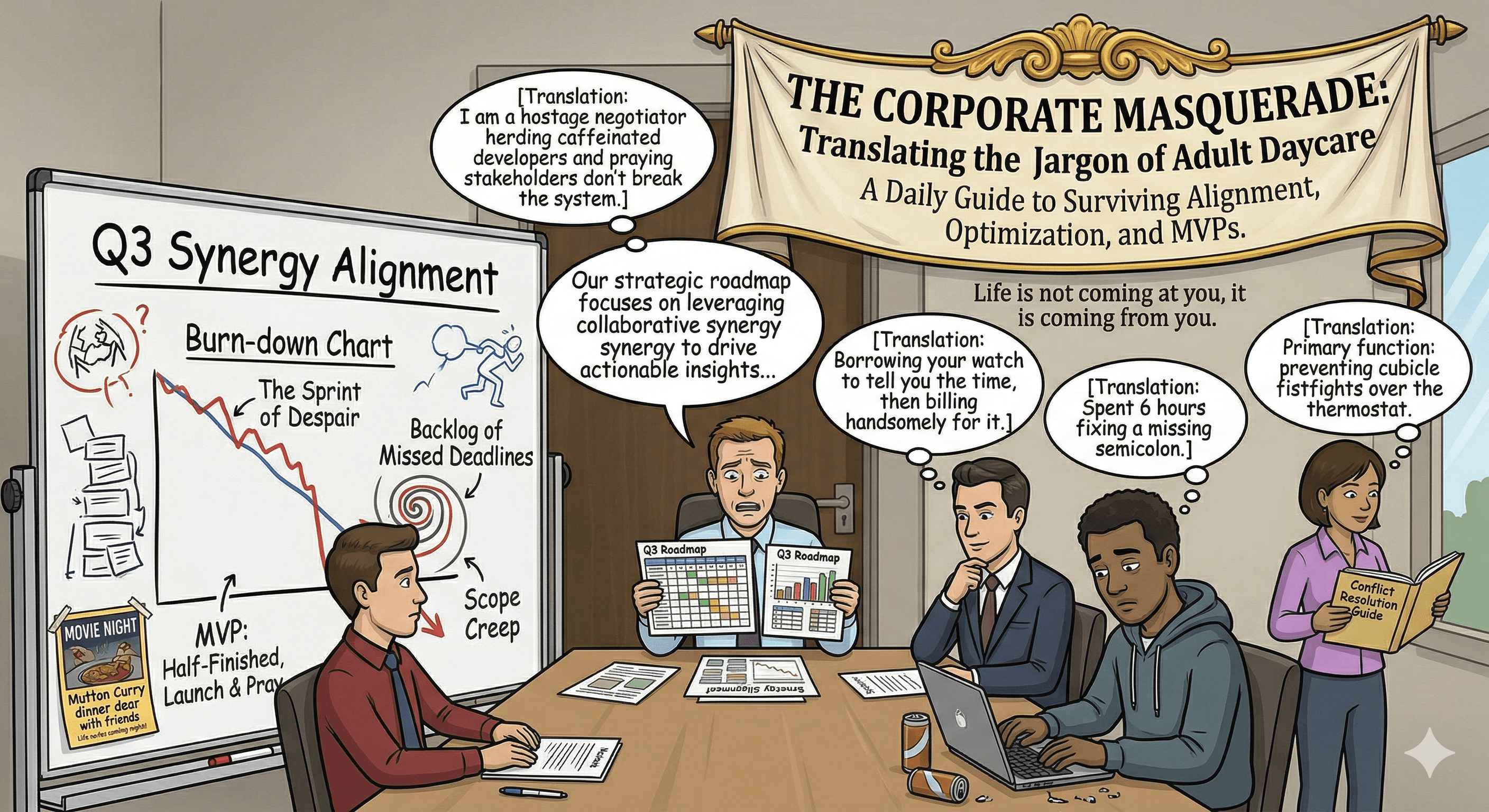
- The Performing Monkey: This involves standing in front of the executive board with a polished slide deck, dancing to the tune of the CEO and their latest shower thought. You are required to defend Q3 roadmap estimates that you literally made up over a lukewarm coffee at eight in the morning, presenting them as a solid, strategic plan rather than a work of speculative fiction.
- The Gilding the Garbage Monkey: This is the most soul crushing phase. You are explicitly tasked with working on something that is absolutely not good. Take the legacy reporting dashboard. It looks like it was built in 2004, it takes three minutes to load, and the analytics show exactly four people use it. But one of those four people is a VP. So, there you are, spending three sprints writing Jira tickets to add an export to PDF button to a feature that should be taken out back and buried. You are actively making the product heavier, just to appease a loud voice.
- The Sacrificial Monkey: When the launch goes beautifully, the engineers are geniuses and the designers are artists. When the servers crash and the churn rate spikes? Bring out the PM. You get the calendar invite for the post mortem.
So, What is a PM Actually Supposed to Do?
If we strip away the juggling, the corporate theater, and the bad features, the core of product management is actually profoundly simple and incredibly difficult. A PM is not supposed to be just an entertainer; they are supposed to be a filter.
Here is what the job looks like when it is done right:
- Being the Chief "No" Officer: A good PM says no to 99 percent of ideas so they can say yes to the 1 percent that actually matter. When a stakeholder bursts in demanding a promotional pop up right over the core user checkout flow, the PM absorbs the blow, says no, and protects the engineering team from the distraction.
- Falling in Love with the Problem, Not the Solution: PMs are not supposed to invent the exact technical fix. They are supposed to obsess over the user pain point. Instead of just building a faster search filter because someone asked for it, a real PM watches users click around in frustration for hours until they realize the user does not need a filter at all, they just need the default view fixed.
- Defining the "Why" and the "What": The PM decides why a feature needs to exist based on business value, and what it needs to achieve. If you try to tell a senior engineer exactly how to structure the database to get it done, you will get bitten.
- Killing the Zombies: Remember working on that legacy dashboard that is absolutely not good? A true PM secretly gathers the data, builds an undeniable business case, and mercilessly assassinates bad features, zombie products, and executive vanity projects. They clear the dead brush so the good ideas can grow.
The Real Life PM Survival Guide
To transition from mere survival to actually executing that ideal job description, you need a few essential tools for navigating the corporate canopy:
- The Jedi Mind Trick: This is the delicate art of validating a stakeholder idea while completely ignoring it. Example: "A rotating 3D carousel on the homepage is a visually stunning idea, David. What if we took that same innovative energy and applied it to streamlining the checkout button first to capture immediate revenue?"
- Strategic Amnesia: Politely forgetting to document feature requests that make absolutely zero sense. If the stakeholder truly needs that neon green blinking notification bell, they will bring it up again. Spoiler alert: they rarely do.
- The Invisibility Cloak: When confronted with a sudden crisis or a bizarre question you cannot solve immediately, simply say, "Let me pull the analytics on that and get back to you." This magical phrase buys you exactly forty eight hours to panic in private and formulate a brilliant plan.
Why Being the Monkey is the Ultimate Compliment
It is easy to feel bogged down when you are handed a mop and told to clean up a hurricane. But when you really think about it, being the monkey is the ultimate positive advantage.
Look at the rest of the corporate animal kingdom. The executives are lions, doing a vast amount of roaring to assert dominance but essentially sleeping twenty hours a day. The highest paid people in the room are hippos, just sitting heavily in the mud, making a lot of noise, and expecting everyone to walk around them.
But the monkey? The monkey is agile. The monkey swings through the chaotic canopy of the organization, navigating tangled vines of office politics with absolute ease. When a hard coconut needs cracking, the monkey figures out how to use the rocks to smash it open.
You are clever, adaptable, and you have opposable thumbs to type up the product requirements. The entire zoo would literally starve if you were not out there foraging for user insights, translating between engineering and business stakeholders, and figuring out how to keep the ecosystem moving.
Embrace the primate energy. You are the problem solver keeping the whole operation alive. And when you finally get to cut through the noise, align a brilliant team, and ship something that genuinely makes a user day better, it is pure magic.
You are not the CEO of the product. You are the agile monkey swinging through a dumpster fire to keep the rest of the zoo alive.